IMPORTANT UPDATE: Effective 1 October 2025, SBIR/STTR program authorization has expired. New activity is paused; ongoing awards remain valid. Awardees are encouraged to contact their TPOCs and contracting officers with questions regarding active awards.


SBIR/STTR Phase III Overview
SBIR/STTR Phase III Purpose
Phase III’s purpose is to rapidly transition a company’s SBIR/STTR effort into hardware or software products, processes, or services that benefit the government or the private sector.
What is a SBIR/STTR Phase III?
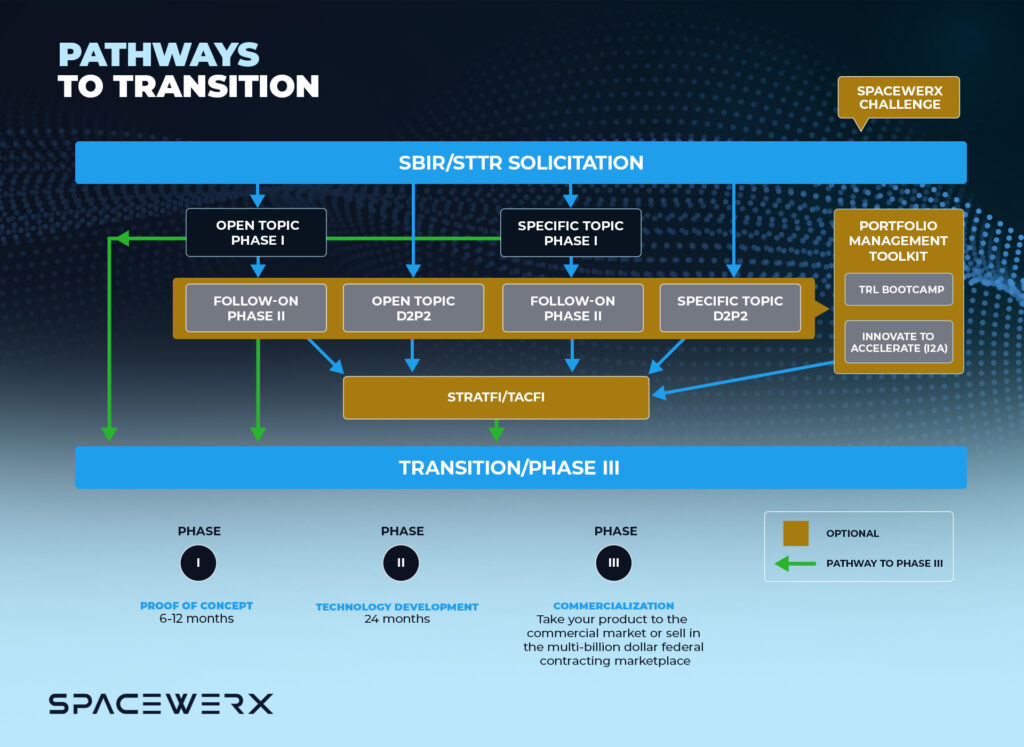
Phase III refers to work that derives from, extends, or completes an effort made under prior SBIR/STTR funding agreements, but is funded by sources other than the SBIR/STTR program.
- “Derives from” is a broad test that refers to work that traces back to SBIR/STTR efforts performed under prior SBIR/STTR funding agreements
- “Extends” means the work can be for other applications not researched or performed in prior SBIR/STTR efforts
SBIR/STTR Phase III
efforts include:
- Products
- Services
- Research/research and development (R/R&D)
- Any combination thereof, including testing and evaluation of products, services, or technologies for use in technical or weapon systems
The following types of activities constitute SBIR/STTR
Phase III work:
- Commercial application (including testing and evaluation of products, services or technologies for use in technical or weapon systems) of SBIR/STTR-funded R/R&D financed by non-federal sources of capital
- SBIR/STTR-derived products or services intended for use by the federal government, funded by non-SBIR/STTR sources of federal funding
- Continuation of SBIR/STTR R/R&D that has been competitively selected using peer review or merit-based selection procedures, funded by non-SBIR/STTR federal funding sources
SBIR/STTR Phase III: Driving Acquisition Transformation Forward

War-Winning Speed and Agility in Acquisition
Phase III awards bridge early-stage R&D to procurement-ready technology for immediate program office adoption
Expansion and Revitalization of the Defense Industrial Base
The SBIR/STTR pipeline actively brings non-traditional and commercial innovators into defense problem spaces
Unified, Outcome-Driven Innovation Ecosystem
Phase III products smoothly transition into operational programs or production, delivering capability from innovation
Commercial Innovation and Dual-Use Pathways
SBIR/STTR Phase III is structured to leverage non-SBIR funding sources to take proven innovations to scale and operational use
Repeatable Transition Pathways
Phase III awards and metrics tracking help institutionalize a feedback loop that:
- Reduces technology risk
- Signals acquisition demand
- De-risks DoW procurement decisions
- Enables metrics-driven outcomes across portfolios
SBIR/STTR Phase III directly supports the Secretary of War’s Acquisition Transformation Strategy by:
- Moving validated technologies into operational use without restarting the acquisition process
- Reducing time to field
- Lowering lifecycle cost through reuse of proven designs
- Enabling rapid scaling aligned to real mission needs
Why Are SBIR/STTR Phase III Awards Important?
Phase IIIs are some of the most effective mechanisms for delivering capability to the warfighter, while simultaneously strengthening the U.S. industrial base:
- Leverage prior government investment in Phases I and II, reducing redundant R&D costs
- Integrate proven, tested technologies into systems faster, minimizing technical and operational risks associated with new deployments
- Flexibilities make Phase III and extremely useful tool for agency officials seeking faster, more efficient ways of accomplishing their missions
SBIR/STTR Phase III Key Attributes
Phase III Competition & Eligibility
Phase III awards do not require further competition (sole source), as Phase I and II competitions satisfy competitive requirements. Federal agencies are required, to the greatest extent practicable, to issue Phase III awards to SBIR/STTR awardee that developed the technology and must make a good-faith effort to do so. Awards may be issued at any time to a small business with a SBIR/STTR Phase I or II, with no limit on the time between phases.
Funding & Award Structure
Phase III awards cannot be funded with SBIR or STTR dollars. However, there is no limitation on the number, duration, type, or dollar value of a Phase III award. A Phase III may take many forms, including a contract, task or delivery order, CRADA, Other Transaction, or subcontract.
Status & Small Business Considerations
Phase III awards retain SBIR status and must include SBIR data rights protections. They count toward small business goals, and small business size limitations do not apply.

SBIR/STTR Phase III Benefits for Small Businesses
Strengthening Competitive Advantage Through Phase III

SBIR/STTR Phase III reduces barriers for small businesses to become established sources for the federal government by providing capital that helps bridge the gap between R&D and the commercial marketplace and expanding marketplace opportunities.
Phase III awards are exempt from SBA size standards and may be issued to companies that have outgrown small business size limits, as well as to novated awardees or successors in interest, such as acquiring companies.
A Phase III contract may be initiated prior to completion of Phase I or II efforts and may also be used as matching funds when applying for STRATFI or TACFI.
Additionally, SBIR/STTR data rights protections extend for 20 years and apply to all phases of the program across both military and civilian agencies.
How Small Business Can Help Themselves
Build Relationships
Small businesses can strengthen their position for continued funding and commercialization by proactively building a strong relationship with the program office that funded their SBIR/STTR Phase I or Phase II effort.
Companies should also identify potential buyers for their SBIR/STTR-derived products or services early on, demonstrating a clear path to market.
Strategic Communication
Maintaining open communication and clearly articulating technical progress throughout each SBIR/STTR phase is essential.
It is equally important to understand and communicate the true value of hte technology—not just its features, but the impact it delivers and the problems it solves.
When proposing Phase III work, businesses should clearly explain how it derives from, extends, or completes the prior SBIR/STTR-funded effort. Providing visuals or illustrations that make the technology understandable to non-technical stakeholders can significantly strengthen the message.
Phase III Compliance & Regulatory Updates
Companies should clearly show how their phase III efforts support the program’s commercialization objectives, including generating private-sector sales whenever possible.
Phase III Information for Government Personnel
Phase III Mandate
Required: DD2579 (Small Business Coordination Form)
Not Required: Sole Source Justification & Approval
Not Required: FAR Part 5 Synopses (Preaward/Postaward)
Data Rights
Federal Procurement Data System—Next Generation (FPDS-NG)
Resources
SBA SBIR/STTR WebsiteSBIR/STTR Policy DirectiveDepartment of War Office for Small Business InnovationSBA SBIR/STTR TutorialsSBA SBIR/STTR Data Rights FAQsDD2579 DAFFARSFAR Part 5 Synopsis ExemptionDAU Contracting Cone - SBIR ProgramsSmall Business Technical CouncilWhat Makes a Phase III So ValuableArmy SBIR/STTR Phase IIINavy SBIR/STT Phase IIIAcquisition GatewayPhase III Overview - SBPhase III Overview - Gov